Archive delivery notes in seconds
Quick summary
Manual delivery-note filing can lead to lost documents, unnecessary copies and delays when an invoice needs checking. The article describes a Papyrus and QR-code workflow that scans a stack of documents and automatically classifies and attaches them to the corresponding delivery note in Tryton.
Contents

If your company receives hundreds or thousands of paper delivery notes every year and you do not have an automated filing system, it is very likely that some of these situations will sound familiar:
- Paper documents are physically moved from the warehouse to the office and, from time to time, one gets lost.
- When the invoice is received, the administration team does not have the delivery note to check the invoice, so it must be located or requested again from the supplier.
- Delivery notes have to be filed manually, taking up time and physical space.
- Several people have access to the delivery-note file and there is a certain lack of control.
- You only allow one person to access the file, which limits the team’s agility and forces the manager to chase colleagues to retrieve the documentation.
- You end up wasting more paper by making unnecessary photocopies.
- You destroy the delivery notes immediately and then do not have them when you need them, or you even fail to meet the legal requirement to keep them (which is necessary, for example, when the invoice refers to the delivery note but does not detail its contents).
Before the paperwork gets lost, we can definitely help you.
A few months ago, we explained how the document management tool can help you manage supplier invoices, which, fortunately, suppliers are now accustomed to sending by email.
The case of delivery notes, however, is usually different. Most companies receive them on paper when the goods arrive, and this is the document the logistics department uses to carry out an initial check of what has been delivered.
After entering the necessary information into the management software or WMS, the question is how to file the delivery note so that it is available, especially when the invoice reaches the administration department.
If you want to avoid moving paper around the company, one possibility is to scan the document in situ and store it in a folder named with the delivery-note number. Or, if the ERP allows it, save the scanned PDF and enter it into the ERP. Some companies try to automate this with optical character recognition (OCR) software, but unfortunately the quality of the document is very often so poor that OCR systems cannot interpret it.
All this leads to manual processes which, although they end with a digitised document, are not much more efficient than managing paper documents, essentially because the documents are managed individually.
Fortunately, the Papyrus document management tool that we have developed at NaN-tic and that you can find integrated into Tryton ERP enables us to optimise this process.
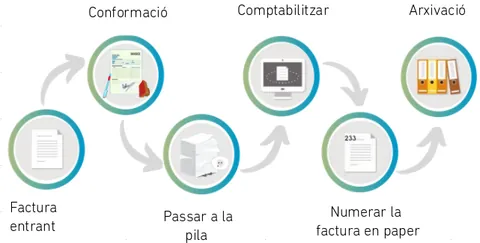
The idea is very simple: when the user enters the supplier’s delivery note into the ERP, they can press a button that sends a QR code directly to a label printer. The label only needs to be attached to the first page of the paper delivery note. The delivery note can be left in a pile while the user starts working on the next one.
At the end of the day (or week), the user takes the entire pile of delivery notes, puts them in the scanner and enters Tryton, where they are automatically classified and attached. They are available effortlessly from the delivery-note screen, and administration or purchasing colleagues can access them with a single click.
The process is so simple and natural that the user does not even have to separate the label from the paper, since some printers issue the label separately.
In this way, the problems of filing and locating information are reduced literally to a few seconds of work at the end of the day or week.
By automating this process, you will achieve:
- Greater control over delivery notes
- Fewer errors
- More physical space
- Greater agility in processes and between departments
- Elimination of low-value manual work for employees.
Contact us and we will start improving your company’s document management. You will see how managing delivery notes day to day becomes faster than reading this article.
Frequently asked questions
How can delivery notes be archived without moving paper around the company?
They can be scanned and linked to the ERP document. With Papyrus, the user prints a QR code, attaches it to the delivery note and later scans the stack so the documents are classified and attached automatically.
Why is OCR not always a good option for delivery notes?
The quality of delivery notes can be so poor that optical recognition cannot interpret the information correctly. The result may still be a manual process that is only slightly more efficient than paper filing.
What are the benefits of automating delivery-note filing?
It improves control, reduces errors, frees physical space, makes access between departments easier and removes low-value manual work.
Related articles

ERP and Business
Papyrus, the tool that improves your document management
Papyrus automates the transfer of invoices from email to Tryton, making it easier to analyse documents, extract information and access attachments. It reduces the errors and time involved in traditional document workflows, while supporting invoices, delivery notes and orders with their related documentation.

Open Source and Trends
Smart stock management
A machine-learning system compares actual stock management with an optimised simulation to calculate thresholds for demand, investment, prices, volumes and stockouts. Integrated with the company’s ERP, it continuously updates those parameters from real data and experience, helping reduce inventory and time purchases more accurately.
Developer
Quality Control in Production Lots and Incoming Shipments
The article explains how to apply quality control to production lots and incoming shipments, associating checks and tests with the relevant processes. This integration keeps quality checks within the receiving and production workflows while preserving traceability of the results.
